Lessons · Lesson 5 of 6
- 01 · The system knew where everything was, and what nothing was made of
- 02 · The unit is chosen before it can be captured
- 03 · The tier boundary, and the floor the claim sets itself
- 04 · What a barcode can honestly do
- 05 · Retrofit against capture, and the answer you cannot buy
- 06 · The passport is coming. Build the records first.
Retrofit against capture, and the answer you cannot buy
Price a reconstruction of a trace after the goods have shipped against creating it while they were being made, and see why the difference is not really about money.
Lesson 5 of 6 · 18 min
The reconstruction
Two years after NW-71408 shipped, Marstrand asked Ranmuthu to say which dye lot was in which carton. The goods had been sold. The style had been dropped. Everybody involved still worked there, and the records were in good order.
Dinesha put three people on it for eleven working days.
| Record | Kept | What it names | Links to |
|---|---|---|---|
| Goods-in log | yes | roll number, dye lot, weight, date | the mill's delivery note |
| Lay sheet | yes | lay number, rolls spread, date | the goods-in log |
| Bundle ticket | printed, then destroyed | bundle number, lay, size, quantity | the lay sheet |
| Sewing output | yes | line, hour, size, count | nothing above it |
| Packing list | yes | carton, size ratio, quantity, date | nothing above it |
Read the last column. The chain runs cleanly from the mill's delivery note down to the bundle ticket. It runs cleanly from the packing list back up to the packing date. Between those two there is one join, and it lived on a piece of card that was pulled off the garments at the packing table and thrown away.
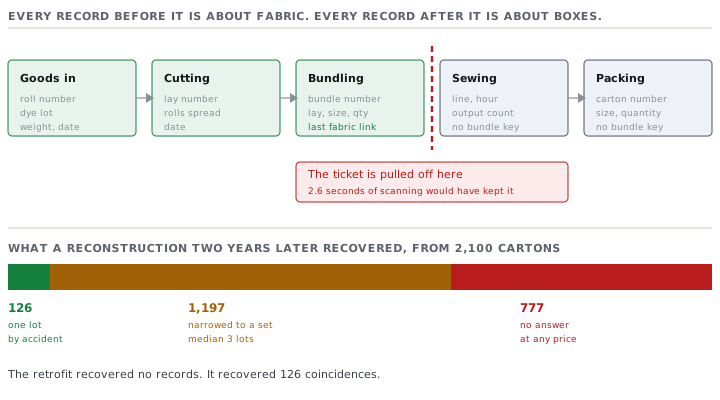
What eleven days bought
The team did the only thing available. It worked by time. A carton's packing date is known. The lays being sewn in the days before that date are known, because the sewing output sheets give line, hour and size. The dye lots in those lays are known from the lay sheets. So a carton can be narrowed to the dye lots that were plausibly on the floor that week.
| Outcome | Cartons | Share |
|---|---|---|
| Resolved to a single dye lot | 126 | 6.0% |
| Narrowed to a set of lots, median three | 1,197 | 57.0% |
| Not narrowed at all | 777 | 37.0% |
Now look at the top row and see what it really is. The 126 cartons that resolved to one lot are exactly the 126 cartons that happened to be packed entirely from one lot. The reconstruction did not recover them. The packing sequence had already done the work by accident, and eleven days of effort merely noticed. The retrofit recovered no records at all. It recovered 126 coincidences.
Three people for eleven days is thirty-three person-days. At Ranmuthu's loaded office rate of USD 78.00 a day, the exercise cost USD 2,574.00.
Against what it would have cost at the time
Everything needed to answer the question exactly was available while the goods were being made, and it was cheap, because none of it is new. The bundle ticket already exists. The dye lot is already on the roll label. The only missing acts are printing one onto the other, and reading it before the card is discarded.
| Line | Amount |
|---|---|
| Change the bundle-ticket print template to carry the dye lot, one day | 78.00 |
| Add a bundle field to the carton record, two days | 156.00 |
| Four handheld scanners for the packing tables, at USD 340.00 | 1,360.00 |
| The scanning itself, 1,400 bundles at 2.6 seconds, at USD 1.95 an hour | 1.97 |
| Total, first order | 1,595.97 |
| Per piece, first order | 0.0380 |
| Every order after this one | 1.97 |
So the comparison is USD 2,574.00 against USD 1,595.97. The retrofit cost 1.61 times the capture. That ratio is the least interesting thing on the page, and quoting it alone would be a mistake, because it invites the reply that the numbers are close enough to gamble on.
They are not close, because they did not buy the same thing.
What Ranmuthu actually sent
Dinesha did not send a confident answer, and this is worth copying.
She sent the three rows of the table above, exactly as measured, with a sentence explaining how each row was derived and a plain statement that 777 cartons could not be narrowed. She also sent the change that had been made for the next order. The dye lot now prints on every bundle ticket, and the ticket is scanned into the carton record at packing.
Nordwyke's answer, when it came, was the useful part of the whole exercise. A set of three lots was a poorer answer than one lot, and an immeasurably better answer than a confident guess, because it could be acted on. Nordwyke could isolate stock, and it knew exactly how much doubt it was holding.
The USD 2,574.00 therefore bought two things: a partial answer, and a precise map of where the break was. That is worth the money if it changes what happens next season, and worth nothing at all if it does not. A factory that runs the reconstruction, files it, and changes nothing has paid USD 2,574.00 to write down its own weakness.
Check yourselfA buyer asks for a per-carton material trace on goods that shipped last year. What do you do first?Show the answer
Find out whether the answer exists before you spend a day looking for it. Walk the chain of records the way this lesson does — what is kept, what it names, and what it links to — and find the join that is missing. That takes an afternoon, not eleven days, and it tells you whether you are running a reporting exercise or a reconstruction. If the join is missing you can say so immediately, offer the coarsest answer you can honestly support, and put the money into fixing the live season instead. What you must not do is start the reconstruction hoping, because eleven days later you will report the same thing you could have reported on the first afternoon, minus the eleven days.
What you should be able to do now
Take one live order — not a shipped one — and price both sides for it. Work out what it would cost to add the capture this week. Work out what a reconstruction would cost in two years if you do not. Then note the thing the second column cannot show: whether the reconstruction would produce an answer at all. Lesson 6 is about the decision that sits behind all of this, taken years earlier by somebody who was not thinking about traceability and was not wrong to.