Lessons · Lesson 2 of 6
- 01 · The system knew where everything was, and what nothing was made of
- 02 · The unit is chosen before it can be captured
- 03 · The tier boundary, and the floor the claim sets itself
- 04 · What a barcode can honestly do
- 05 · Retrofit against capture, and the answer you cannot buy
- 06 · The passport is coming. Build the records first.
The unit is chosen before it can be captured
Put the units of one order on a ladder, find where the factory's own capture sits on it, and tell apart a unit that is merely too coarse from a unit that cuts across the thing you are being asked about.
Lesson 2 of 6 · 20 min
Eight units, and one of them is not on the ladder
Every physical thing in this order exists at some level of grouping. The levels sit inside one another like a nest of boxes. Start at the top of the chain and walk down.
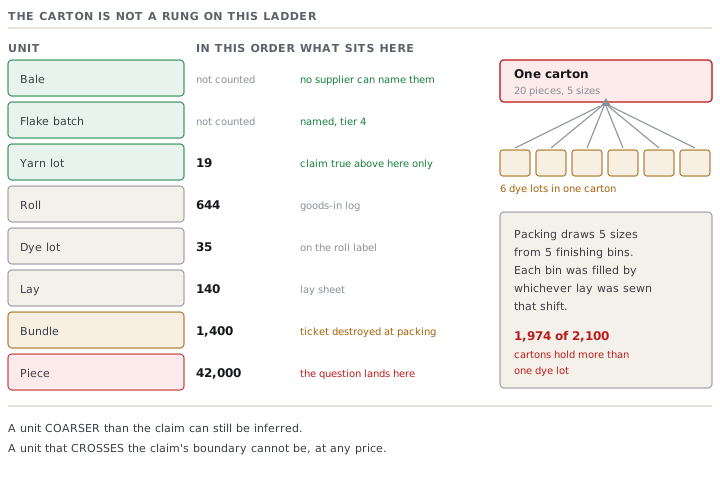
- Bales of collected bottles arrive at a recycler. Nobody in this chain can name them.
- Flake batches come out of that recycler — Haixin Polymer, in this order.
- Yarn lots come out of the spinner, Tongrui. Nineteen of them fed NW-71408.
- Rolls come off Weilan's knitting machines: 644 of them, averaging 60 kg.
- Dye lots group those rolls through the dyehouse: 35 lots for this order.
- Lays are spread in Ranmuthu's cutting room. A lay is a stack of fabric layers spread out flat and cut in one go. There are 140 of them, 60 plies deep on a five-size marker, 300 garments each.
- Bundles are tied out of each lay: 10 a lay, 30 garments each, 1,400 in all.
- Pieces — 42,000 of them.
Now notice what is missing from that list. The carton is not on it. A carton is not a stage of manufacture. It is a way of putting finished garments in a box for shipping, and Nordwyke's carton holds 20 pieces in a 2/5/6/5/2 size ratio.
That is the whole lesson in one observation. The unit Ranmuthu captured is not a unit of the thing being asked about. It is a unit of logistics, sitting sideways across a ladder of manufacture. Lesson 6 is about why a sensible person chose it.
Coarse is survivable. Crossing is not.
A record can be at the wrong grain in two different ways, and people treat them as one problem. They are not one problem, and the difference decides whether an answer can be recovered.
Too coarse means your record is about a bigger group than the question. Suppose Ranmuthu recorded only that carton 1163 was packed on a certain day from a certain lay. That is coarser than a piece. But every garment in that carton inherits the lay's properties, so the piece-level answer follows by inference. Coarse is a nuisance. It is not fatal.
Crossing means your unit contains parts of more than one of the things the question is about. A carton holding pieces from 6 dye lots inherits nothing. No property of the carton is true of every garment in it. So nothing can be inferred downward, and no amount of later effort recovers it.
| Unit | How many | Fabric or pieces each | Does it stay inside one dye lot? |
|---|---|---|---|
| Dye lot | 35 | 1,104 kg | by definition |
| Lay | 140 | 276 kg, 300 pieces | 109 of them do |
| Bundle | 1,400 | 30 pieces | all of them do |
| Carton | 2,100 | 20 pieces | 126 of them do |
Read the last column downward. The bundle is the finest unit in this factory that never crosses a dye-lot boundary. A bundle is cut from one ply stack in one lay, and it is tied before it leaves the cutting table. The carton is the coarsest unit that almost always crosses one: 1,974 of 2,100 cartons hold pieces from more than one dye lot, which is 94.0%, and the worst holds 6.
So the bundle is the answer, and it was sitting there the whole time. It is not a new record to invent. Ranmuthu already prints a bundle ticket for every one of the 1,400 bundles, carrying the lay number, the size and the quantity. What the ticket does not carry is the dye lot. And what nobody does is read the ticket before it is thrown away.
Choosing the unit is a decision, and it is made once
Here is the practical method. It is three questions, asked in this order, for every claim you make about a product.
First: what is the finest unit at which this claim was ever true upstream? Not the finest unit you would like. Lesson 3 is entirely about this question, because the answer for a recycled-content claim is startling, and it sets a floor nothing downstream can dig under.
Second: what is the finest unit at which somebody will ask? Today, for most factories, it is the delivery. The direction of travel is the piece, and a piece-level demand does not arrive politely a season in advance.
Third: what is the finest unit you can carry through your own process without crossing a boundary? For a garment factory that is nearly always the bundle, for the reason above. For a mill it is the dye lot or the roll. For a spinner running a blending line, it may honestly be nothing finer than a production week.
The answer you can give is the coarsest of those three, and you cannot improve it by working harder on the other two. That is the sentence to keep.
| Question | Answer for this order |
|---|---|
| Finest unit at which the claim was true upstream | the spinner's accounting period |
| Finest unit at which the buyer is asking | the piece |
| Finest unit Ranmuthu could carry without crossing | the bundle |
| Therefore the finest honest answer | the spinner's accounting period |
That table is uncomfortable, and it is the honest position. Ranmuthu could build a perfect piece-to-bundle-to-dye-lot chain, at a cost lesson 5 puts at USD 1,595.97. It would still not make "this jacket contains recycled polyester" a provable statement about this jacket, because the property was never attached to any jacket, or to any yarn lot, anywhere upstream.
What that chain would do is make the quality answer exact, make the chemical answer exact, and put Ranmuthu in a position to use a finer upstream claim the day one becomes available. It is a prerequisite, not a solution. Sell it as one.
Check yourselfYour goods-in log records the dye lot of every roll, and your packing list records every carton. Somebody asks which dye lot is in a particular garment. Why can you not simply join the two?Show the answer
Because nothing links them. A join needs a shared key, and the only thing that ever held both a fabric identity and a garment identity at the same time was the bundle — the stack of panels cut from one place in one lay. Once the bundle ticket is removed at packing, the fabric side of the chain and the carton side of the chain have no common column, and never will. You do not have a reporting problem. You have a missing record, and a missing record cannot be reported around.
Prompt · Map the units of my product and mark where my capture actually stops
Before you scope a traceability system, buy a labelling module, or answer a buyer's questionnaire. It tells you which unit you are being asked about, and which one you can actually deliver.
Act as an industrial engineer who designs traceability at the level of units rather than of systems. Build me a granularity map for one product. The product and its material chain, as far up as I know it: [FIBRE OR POLYMER, YARN, FABRIC, DYEING, CUTTING, SEWING, FINISHING, PACKING — name the party at each stage, or UNKNOWN]. One real order to hang numbers on: [QUANTITY, FABRIC CONSUMPTION A PIECE, ROLL SIZE, DYE OR BATCH SIZE, LAY SIZE, BUNDLE SIZE, PACK SIZE]. The claim I make about this product: [THE CLAIM, WORD FOR WORD AS IT APPEARS ON THE LABEL OR THE SPEC]. Produce four things. First, the ladder: every unit from raw material to piece, in order, with the count of units in this one order at each rung, and the arithmetic that gives each count so I can check it. Second, for each unit, whether it stays inside one batch of the level above it or crosses that boundary, and say plainly that a unit which CROSSES cannot be resolved downward by any later effort while a unit that is merely COARSER can. Third, mark three points on the ladder: the finest unit at which my claim was true upstream, the finest unit at which somebody is asking, and the finest unit I capture today. Then tell me which of those three is binding, because the answer I can honestly give is the coarsest of the three. Fourth, name the single unit in my own process that is the finest one never crossing a boundary of the level above, since that is the unit worth capturing, and tell me which existing document already identifies it. Show every calculation. Do not tell me what to buy and do not use the word platform.
AI can make mistakes — check anything you act on.
What you should be able to do now
Draw the ladder for one of your own products: every unit from raw material to piece, with a count for one real order at each level. Then mark three things on it. Where your capture actually happens. Where the claim you make was true upstream. And where the question is being asked. Lesson 3 goes up the ladder to the top, where the most important of those three marks turns out to sit much higher than anybody expects.