Lessons · Lesson 1 of 6
- 01 · The system knew where everything was, and what nothing was made of
- 02 · The unit is chosen before it can be captured
- 03 · The tier boundary, and the floor the claim sets itself
- 04 · What a barcode can honestly do
- 05 · Retrofit against capture, and the answer you cannot buy
- 06 · The passport is coming. Build the records first.
The system knew where everything was, and what nothing was made of
Tell apart the question a tracking system answers and the question a tracing demand asks, and watch two unrelated complaints arrive in one week and die at the same missing record.
Lesson 1 of 6 · 20 min
The order, and the week two questions arrived
Ranmuthu Apparel is a knitwear and outerwear factory at Horana, in Sri Lanka. It runs eleven sewing lines and it is good at its job. Everything in this course happens on one order.
- The buyer is Nordwyke, an outdoor and mid-layer brand in Silkeborg, Denmark.
- The order is purchase order NW-71408: 42,000 pieces of style NW-4180. It is a women's 300 gsm grid-fleece mid-layer in the colourway Peatsmoke, FOB USD 18.40. The order is worth USD 772,800.00.
- The fleece is knitted and dyed by Weilan Knitting Mills at Changhua, Taiwan, from staple fibre supplied by Tongrui Fibres at Taoyuan.
- The fleece is sold as recycled polyester, both on the swing ticket and on Nordwyke's product page.
Four people appear in this course. None of them does anything foolish.
- Dinesha Weeratunga runs systems at Ranmuthu. She built the barcode system four years ago.
- Sunil Abeynayake runs the cutting room. He owns the lay sheets.
- Chamari Ilangakoon supervises finishing and packing. She owns the packing tables.
- Kirsten Marstrand is Nordwyke's sustainability and compliance manager, in Silkeborg.
In the second week of October, two questions reached Ranmuthu four days apart. They came from two different departments at Nordwyke, and nobody connected them.
The first, from Marstrand: Nordwyke is preparing for a product passport. It wants to state the recycled content per item, with the evidence behind it. Not per order. Per garment.
The second, from Nordwyke's quality team: 340 jackets have come back from stores with a surface fault. The grid face has gone flat and pilled after a few wears. Which production is it confined to?
Ranmuthu answered the first in four minutes and never answered the second. By the end of this lesson you will see that those are the same failure.
Two words that are not synonyms
Ranmuthu's barcode system is genuinely good. Every carton is labelled and scanned at packing, again at the finished-goods store, and again at loading. Nordwyke's warehouse scans the same code on receipt. Dinesha can tell you in seconds which container any carton left on, and which day it was checked in at the other end. When she built it, receiving a container at Ranmuthu's own store fell from 4.4 hours to 1.3 hours. That is 3.1 hours saved on every container, for four years.
That system answers one question extremely well: where is it?
The two questions that arrived in October ask something different: what is in it, and how do you know? No amount of the first produces the second. The reason is not effort and it is not money. They are different verbs.
| Tracking | Tracing | |
|---|---|---|
| The question | Where is my order, and where has it been? | What is in this garment, and prove it |
| Direction | Forward, from now | Backward, from the object |
| Natural unit | The thing that moves — a carton, a pallet, a container | The thing a claim is about — a lot, a batch, a piece |
| What satisfies it | A scan and a timestamp | A chain of records that link an input to an output |
| When it can be built | Any time, and it works immediately | Only before the goods are made |
| Who asks | Your planner, your buyer's warehouse | A regulator, a customer, a claim, a recall |
The row that matters is the last one but one. A tracking system installed tomorrow starts working tomorrow. A tracing capability installed tomorrow tells you nothing about anything already made. And if you are reading this because a buyer has asked, the goods they are asking about have usually already shipped.
What the first question actually asked
Marstrand's request looked easy. Ranmuthu's merchandiser answered it in four minutes: the fleece is recycled polyester, here is the mill's certificate, here is the transaction certificate covering the delivery.
Every word of that is true. It is also an answer about the order. It says the fabric bought for NW-71408 was bought as recycled. It says nothing about any particular jacket, because nothing in the file is about any particular jacket. Forty-two thousand garments are covered by one sentence, and the sentence is the same for all of them.
For four seasons that was enough, because nobody asked at a finer grain. The direction of travel is that somebody will.
What the second question cost
The quality question is where the money is, and it is the one a factory owner feels.
Ranmuthu's own laboratory found the fault quickly. A section of the fleece had been sheared slightly harder in finishing, and the grid face on that fabric loses loft after a few wash cycles. It is one dye lot — one batch of fabric dyed together in a single machine load. The mill dyed the order in 35 lots, so a lot is 1,200 garments' worth of fabric.
So 1,200 pieces of a 42,000-piece order have the fault. Ranmuthu cannot show which 1,200, so all 42,000 are suspect. That is an exposure 35.0 times the size of the real problem.
| Line | Amount |
|---|---|
| Pieces actually affected | 1,200 |
| Rework and return, at USD 3.20 a piece, if it could be confined | 3,840.00 |
| Pieces that had to be treated as suspect | 42,000 |
| Settlement agreed with the buyer, at USD 0.44 a piece | 18,480.00 |
| The cost of not being able to point | 14,640.00 |
USD 14,640.00, and not one cent of it is about the fault. The fault was a mill problem with a mill remedy. The USD 14,640.00 was bought entirely by one missing link: nothing joined a garment to the dye lot it was cut from. As lesson 5 will price it, that link would have cost USD 1,595.97 to create for the whole order, once.
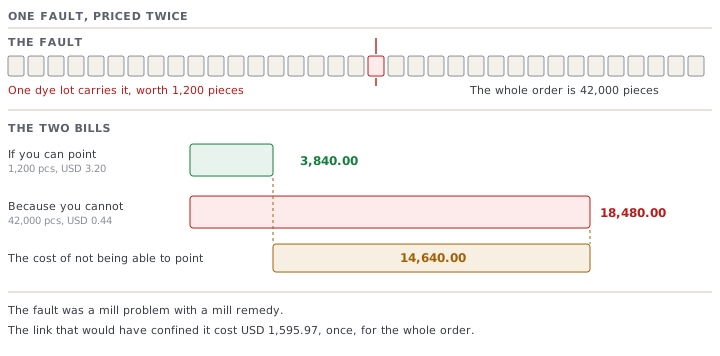
Two complaints, one cause
Here is the part worth taking to a management meeting.
Ranmuthu's quality manager had been asking for lot traceability on the cutting floor for two years. Each time it was written up as a quality improvement. Each time it was costed at a few hundred dollars. Each time it lost to something with a bigger number next to it. Nobody was wrong to push it down the list. On its own, framed as a quality nicety, it did not clear the bar.
The recycled-content question was filed somewhere else entirely. It was a sustainability matter, with a different owner and a different budget line.
They are one record. The link from a garment to the fabric lot it was cut from is what confines a recall. It is also what makes a material claim true of a specific garment instead of an average. A factory that builds it once has answered a quality problem, a chemical-compliance problem and a product-passport problem with the same field on the same ticket. A factory that keeps arguing about which department pays will buy it three times, or not at all.
Check yourselfYour buyer's warehouse can see every carton of your order by the hour, and your own store has scanned every one. Does that mean you have traceability?Show the answer
No. That is tracking, and it is worth owning — it tells you where goods are and when they moved. Tracing runs the other way. It starts from an object and asks what went into it. The two use similar-looking technology and answer completely different questions, so building the first extremely well does not move you one step towards the second. The test is simple: take one garment, not one carton, and ask what it is made of and how you know.
Prompt · Find the exact point where my chain goes dark, on one order I have already shipped
When a buyer has asked what is in a garment and you are not sure you can answer. Or before anybody asks at all, on a quiet afternoon, using one order you have already shipped.
Act as a traceability auditor who has taken apart real factory record chains and who cares only about joins, not about systems or software. I will describe one order I have already shipped and the records I keep. Your job is to find the exact point where the chain from raw material to finished garment is cut, and to say what can and cannot be answered on either side of that cut. My product and process: [DESCRIBE THE GARMENT, THE MATERIAL AND EVERY PROCESS STEP FROM GOODS IN TO CONTAINER]. My records, step by step, and for each one tell me: [WHAT IT IS CALLED, WHAT IDENTIFIERS IT CARRIES, WHO FILLS IT IN, WHETHER IT IS KEPT AND FOR HOW LONG]. If you do not know whether a record exists, say UNKNOWN and I will go and look. Do the following in order. First, lay my records out as a chain and, for each pair of adjacent records, name the shared field that joins them; where there is no shared field, say so plainly and mark it as a CUT. Second, for every cut, tell me what the last record above it can prove and what the first record below it can prove, so I know exactly what I still hold. Third, work out the finest unit at which I could honestly answer the question WHAT MATERIAL IS IN THIS GARMENT, and state it as a unit, not as a percentage of confidence. Fourth, tell me which of my records is physically destroyed during the process and at which workstation, because that is usually where the cut is. Fifth, give me the shortest possible list of changes that would close the cut, and for each one say who does it, at which workstation, how many seconds it adds per unit, and whether it needs any equipment I do not already own. Do not recommend software, a platform, a blockchain or a serialisation programme; I am asking about records. Where you need a fact I have not given you, name it and ask for it instead of assuming it.
AI can make mistakes — check anything you act on.
What you should be able to do now
Take one order you have already shipped. Write down the finest unit at which you can honestly answer "what is in this?" — order, delivery, carton, cut, or piece. Then write down the finest unit at which somebody has asked you, or is about to. If those two are not the same unit, you have found the whole subject of this course. Lesson 2 is about why the gap between them is decided long before anybody asks.